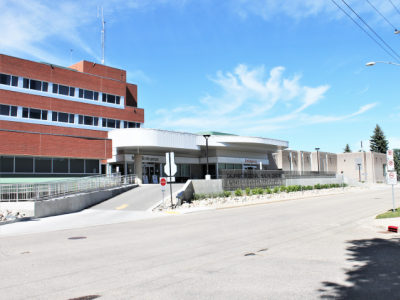
On Tuesday and Wednesday, Riding Mountain MP Dan Mazier visited the Parkland to speak with residents and organizations about the various challenges they face. One of the most troubling things to him was the amount of uncertainty surrounding the Dauphin Regional Health Centre.
Yesterday, he wrote an open letter to Manitoba's Minister of Health, Seniors and Long-Term Care, Uzoma Asagwara. In the letter, he speaks on the lack of communication from Prairie Mountain Health on the future of the facility, the possibility of politcs playing a part in what should be a non-partisan issue, and the serious concerns he's heard from health care officials in the region over the past few days.
"You know, that letter went out for a reason. Like, all we're hearing right now is the province is still assessing, we're still assessing. Meanwhile, it took days, almost over a week to get the water out and start drying the [Dauphin Regional Health Centre] out, it's almost like it's an afterthought, to get the building up and running again...you go to any residence, any private business, anybody that's been flooded out, it's all hands on deck, and people [are] coming in from all over the country and all over the world here to help us out, all over the riding, except in that hospital. And that is totally unacceptable," said Mazier during an interview.
One of Mazier's top concerns is the strain the DRHC's closure is putting on an already stressed provincial healthcare system. With the closure comes the unavailability of several specialized services, including cancer care. Both diagnostic services and the emergency department are fully unavailable, meaning both patients and staff are having to travel further to receive and provide care.
"When you stop and think about this, we have doctors, we have nurses in our communities, that are being asked to go serve somewhere else, and fit in to their other places that didn't have their hospitals shut down, so what's that doing to our whole system, it just speaks to the lack of capacity and the lack of reaction," said Mazier.
In his letter, Mazier highlights serious concerns he's heard from regional healthcare professionals and residents about the lack of communication and timely information when it comes to the DRHC. In trying to book a simple visit and meeting with Prairie Mountain Health officials, Mazier and his team faced a two week delay, and were offered a Microsoft Teams meeting as opposed to an in-person visit.
Mazier said most of the people he's spoken to outside of what he called the "Healthcare Bubble" don't know the severity of the problem, in large part because of the severe lack of communication from Prairie Mountain Health and the Provincial Government.
"I thought it'd be a lot more urgency, and I'm not sensing that at all from the ministry, the Health Minister, the Government," said Mazier.
Mazier urges concerned residents, and especially healthcare professionals, to tell their stories. He said being vocal to your local MLAs and MPs is a good way to raise attention to the severity of the DRHC's closure.
"Definitely don't be scared to tell your story if you're a healthcare worker, and tell your MLA, you can go ahead and tell your MP...the more the community can push, it makes it easier for all of us elected officials to do what we need to do as well to get the Government's attention, like it needs to be a really coordinated effort," said Mazier.
In the last paragraph of his letter to Minister Asagwara, Mazier said he has called for targeted federal assistance to suppor the restoration of hospital services, but delayed responses and absent leadership have delayed the ability to support affected residents. He also commented on the lack of communication from all parts of the Provincial Government.