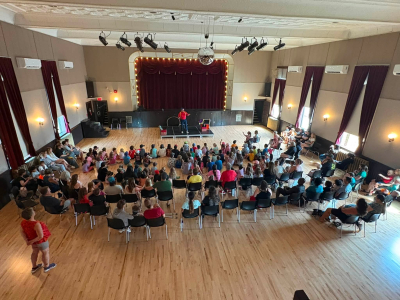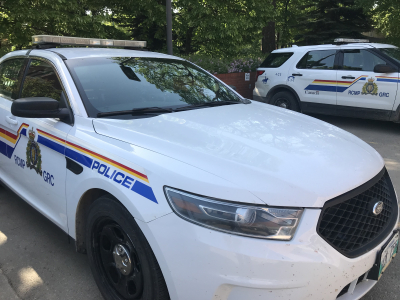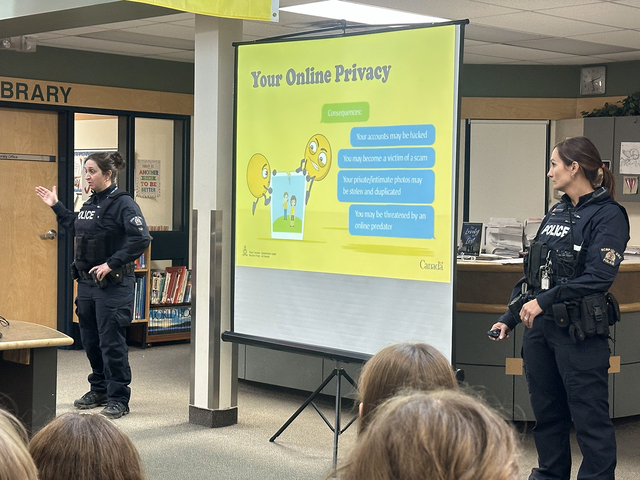
The Manitoba RCMP recently held online safety information sessions at schools in Dauphin.
While each presentation was adapted according to the student’s age, the topics covered included the dangers of speaking to strangers online and the sharing of naked or semi-naked images with others (whether their own or from someone else).
The biggest safety tip was to never share anything online.
"Your date of birth, address, where you live, where you go to school, that should be private," Constable Joanie Duguay said. "Do not talk to strangers online, it's the same thing as meeting them. You're not going to share all your information with someone you don't know the first time you meet or talk to them."
When it comes to social media, Duguay says your friends list should only contain people you know. Since the beginning of the COVID-19 pandemic, the RCMP has received a high number of exploitation cases.
"That's why we are focusing on preventing at school so students know the dangers of social media," continued Duguay. "There are good things about social media, but there are bad things as well. We have definitely seen an increase."
In Winnipeg in 2020, the Police Service had 19 extortion reports. Five years later, in 2025, that number skyrocketed to 223. While historically young men have been affected, recent statistics show a surge in boys being targeted.
If you believe you're being targeted, Duguay says, speak to your parent or guardian. You can also report it at CyberTip.ca.
"You can report online if you're scared to pick up the phone or to go to a trusted adult," ended Duguay. "You share everything you need. CyberTips will reach out to the appropriate jurisdiction. If it's within RCMP jurisdiction, that report will come directly to us."
In 2020, the Canadian Centre for Child Protection says there were 458 sextortion victims across Canada. In 2025, that number ballooned to 2,827